What is CAN bus and what is it used for?
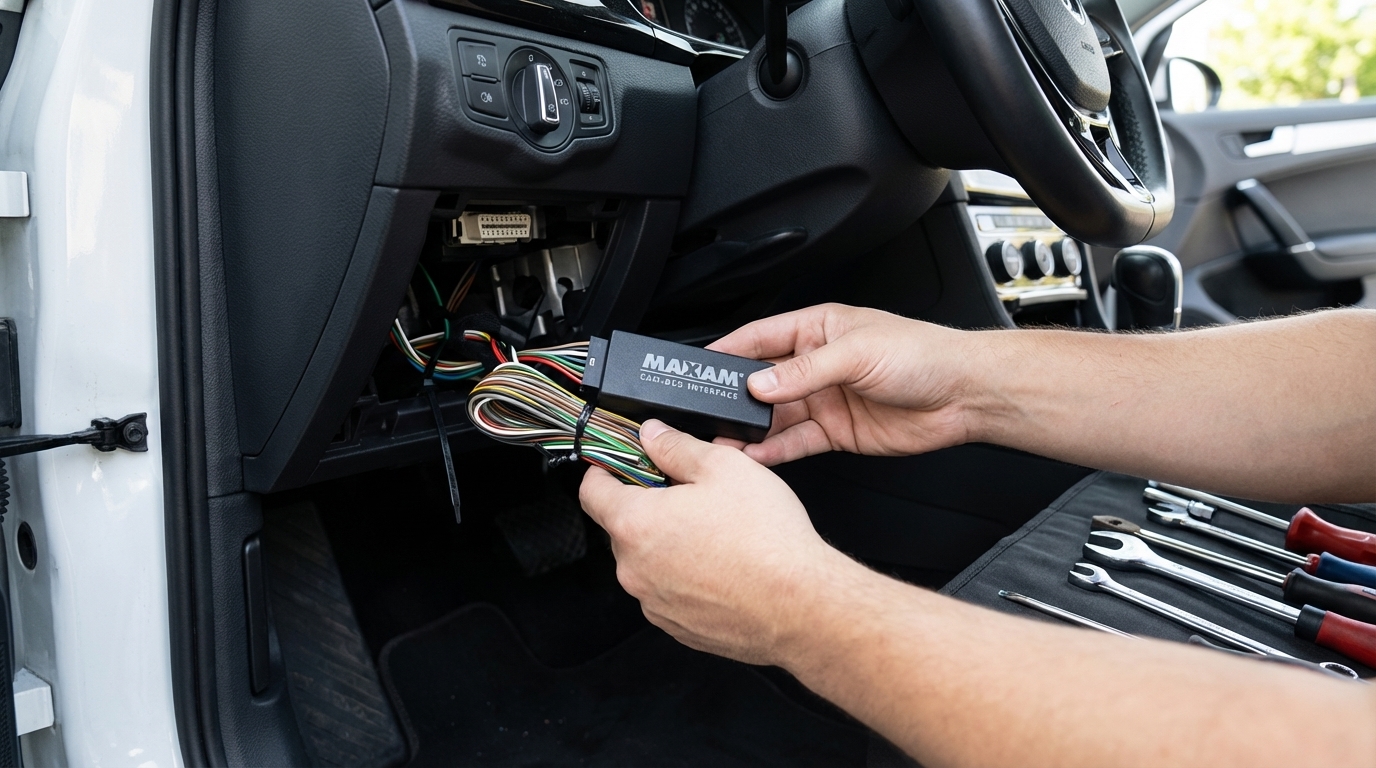
What is CAN bus and what is it used for?
In modern vehicles, almost everything revolves around communication between electronic components. From door modules and lighting to engine management, infotainment, and driver assistance systems — they continuously exchange data. CAN bus is one of the key technologies that makes this possible.
In this blog, we clearly explain what CAN bus is, what it is used for, and why it is so important for installers and garages.
Learn more about our CAN integration solutions:
https://vos.be/en/products/can-bus-interfaces
What does CAN bus mean?
CAN stands for Controller Area Network. It is a communication protocol used in the automotive industry that allows different electronic control units (ECUs) to “communicate” with each other via a shared data line (the bus).
Instead of running a separate wire for every function (as was often done in the past), vehicles today transmit data as digital messages over the CAN network.
In short: CAN bus is the vehicle’s internal data network.
Why was CAN bus developed?
Vehicles contain an increasing amount of electronics. Without CAN bus, the wiring harness would become:
-
much heavier and thicker
-
more complex to assemble and maintain
-
more error-prone due to the high number of connections
-
more expensive to produce
CAN bus makes it possible to control more functions reliably with less wiring.
How does CAN bus work in practice?
A CAN bus typically consists of two wires:
-
CAN High
-
CAN Low
These two wires operate together as a differential signal, helping to suppress interference (noise/EMI). Control units send messages (frames) onto the bus, and other modules “listen” to them. Only the module(s) for which the message is relevant will respond.
Important: there is usually no single “central computer” controlling everything. It is a network in which multiple modules can send and receive messages.
What is CAN bus used for in a vehicle?
CAN bus is used to share numerous vehicle data and functions, such as:
-
Ignition status (+15)
-
Door status (open/closed)
-
Reverse signal
-
Brake pedal signal
-
Vehicle speed signal
-
Engine speed (RPM)
-
Lighting status
-
Steering wheel controls and buttons
-
Comfort functions (e.g. central locking)
-
Diagnostic information (depending on the network)
For installers, this is particularly important because many traditional “analog” signals are no longer easily available on a single wire, but instead exist as data on the CAN network.
What does this mean for installers and garages?
1) Faster access to the correct signals
When installing retrofit accessories (e.g. cameras, alarms, track & trace systems, cruise control, etc.), you often need signals such as ignition, reverse, or speed. In modern vehicles, these signals are often reliably available via CAN — provided they are read correctly.
2) Less invasive installation (when done properly)
By using the correct interface and proper connection methods, installations can often be:
-
cleaner
-
less invasive to the original wiring
-
less prone to incorrect trigger signals
3) Greater need for accurate diagnostics
CAN enables more advanced installations, but also increases sensitivity to:
-
poor connections
-
tapping into the wrong network
-
modules that prevent the vehicle from going to sleep (quiescent current issues)
Proper measurements, documentation, and high-quality materials remain essential.
Are there multiple CAN buses in one vehicle?
Yes, often. Modern vehicles frequently have several networks (e.g. comfort, powertrain, infotainment), sometimes connected through gateways.
Therefore, simply connecting to “CAN High and CAN Low” is not always sufficient — you must connect to the correct network for the signals you need.
Reading CAN bus data: how is it done?
In practice, CAN data is accessed using:
-
diagnostic equipment (for diagnostic purposes)
-
CAN bus interfaces that make relevant signals available for aftermarket applications
A CAN bus interface can, for example, provide signals such as:
-
ignition
-
speed
-
RPM
-
brake
-
reverse
-
door status
View our CAN solutions category:
https://vos.be/en/products/can-bus-interfaces
Frequently Asked Questions (FAQ)
Is CAN bus the same as OBD?
Not exactly. OBD is a diagnostic interface/standard (an access point), while CAN bus is one of the networks/protocols over which vehicle data is transmitted. Many vehicles use CAN via the diagnostic connector, but they are different concepts.
Is CAN bus immune to interference?
CAN is designed to be robust, but installation quality remains critical. Poor connections, incorrect tapping points, or faulty modules can still cause malfunctions.
Can you retrieve every signal from CAN?
Not always. It depends on the vehicle, the network, security restrictions (some data is protected), and where you connect. Vehicle-specific knowledge — or a suitable interface solution — is therefore important.
Need help with a specific application?
Are you working on an installation that requires CAN signals (ignition, reverse, door status, speed…)? We’re happy to help you think it through.
CAN bus interfaces:
https://vos.be/en/products/can-bus-interfaces
Contact:
https://vos.be/en/contact
VOS – CAN-bus InterfacesVos Car Electronics, your B2B specialist in electronic and electrical automotive accessories
|